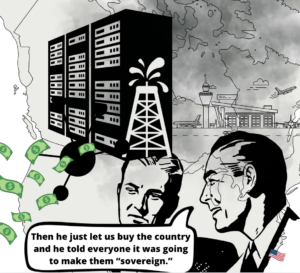
Canadians, including Albertans, wanted a stronger, faster industrial carbon pricing system

New Polling Shows Industrial Carbon Pricing Should be Stronger, Pipeline Should Not be Federally Financed, and Albertans Agree

Media Release: For Immediate Release, Wednesday May 27th, 2026

New polling from Abacus Data shows Canadians are more than twice as likely to support increasing Alberta’s industrial carbon price to $130 per tonne by 2030 (47%) than delaying this increase until 2040 (22%). In Alberta, where new rules for carbon pollution are set to take hold under a deal between the federal and provincial governments, more people (43%) supported that 2030 target than a delay to 2040 (33%).

This information comes as the Federal Government failed to negotiate a $130 per tonne by 2030 price and instead gave in to a severely weakened and delayed Industrial Carbon Price – that could “decimate” vital green industries and jobs according to Canada’s Clean50 founder. Canada’s national industrial carbon price was set to rise to $170 per tonne by 2030. Instead, Alberta’s will be delayed to 2040 and the minimum carbon price only reaching $110 as experts from the International Institute on Sustainable Development have confirmed.

The polling also shows that – if a pipeline to the west coast of BC were to go ahead – Canadians say it should be financed privately (39%), with only 28% saying the federal government should finance it. Again, even in Alberta 42% percent say it should be financed privately, while only 34% say it should be financed federally. This also holds true across the political spectrum of voters.

Additionally, the polling indicates in a broader sense strong support for government regulations to limit oil and gas corporations’ greenhouse gas emissions. 7 out of 10  Canadians support such regulations. Alberta also sees a strong majority (62%) in favour of such regulations and only 20% opposed.

Journalists can request polling details by contacting us at Media@sierraclub.ca

“These polling results show Canadians support holding oil and gas companies to account for their pollution. The oil and gas industry has played the federal government like a fiddle, says Gretchen Fitzgerald, Executive Director at Sierra Club Canada. “Weakening industrial carbon pricing should never have been on the table in this negotiation – the only winners here are oil and gas corporations – our country and our climate security are the biggest losers in this ‘deal’.”

Sierra Club Canada says that should a pipeline be built, any public financing would effectively leave the public with the bill, as there is no market case for a new pipeline to the west coast. As an example Sierra Club Canada  points to the Trans Mountain pipeline, which the Federal Government claimed would find a private buyer, but which now will likely end up in public hands indefinitely as no private sector actor is interested in it.

“This polling shows people across Canada, including Alberta, want stronger climate policies than what we’ve got and don’t want the Federal Government to finance yet another risky pipeline. Canadians know that a new pipeline is not a sound investment for public dollars – especially since Trans Mountain failed to find a private sector buyer,” says Conor Curtis, Director of Communications at Sierra Club Canada.

“What’s problematic about these climate policy rollbacks is that they are being done to appease what appears to be a small portion of the Canadian public, even in Alberta, to little effect. If history is any guide, all that will do is embolden that smaller group to be even more ambitious and tell them if they get louder they’ll get what they want. This never-ending appeasement is going to actually harm national unity.”

Sierra Club Canada says, despite claims to the contrary, Canadians’ support for climate policy and renewable action remain high. They also say this shows consistency with other previous polling – by various sources – suggesting Canadians supported the now canceled emissions cap and would prefer renewable energy development to oil and gas development (see below).

For example, previous polling by Abacus Data from June 2025 had found that 72% of Albertans wished to maintain or increase federal climate action.

The Federal Government is already exploring pipeline financing via the Indigenous loan guarantee program. If LNG is any indication, that would result in significant financial risks for Indigenous communities. The Federal Government also recently announced a ‘sovereign wealth fund,’ the purpose of which appears to be inverse to that of Norway’s fund (i.e. it transfers risk from projects onto the public). Exporting more oil and gas would actually make the cost of living in Canada worse, as illustrated by Australia’s example of increasing gas exports leading to increasing costs for everyday consumers. Instead of handing over public dollars to massive oil and gas corporations, Canada should instead  tax windfall oil and gas corporate profits and reinvest the revenue in renewable alternatives or redistribute it to consumers, according to recent research by the Centre for Future Work.

-30-

For information and interviews please contact: Media@sierraclub.ca

For context: Instead of reaching $130 per tonne by 2030, the industrial carbon price negotiated under the MOU instead allows the minimum price to be only $115 in 2030, while the effective carbon market price (what credits trade at) will be only $60 in 2030, and $110 in 2040.

According to previous polling from multiple sources:

  • 58% of Canadians say transitioning away from fossil fuels toward renewable energy is more important than ever, in light of U.S, aggression towards other countries [only 11% say less] – Opinium, February 2026: https://www.sierraclub.ca/clean-energy-polling-canada/
  • As of September 2025, Abacus Data polling had found that  “70 per cent of the public would feel pride if Canada were to become a renewable energy superpower, versus only 30 percent feeling that way about becoming an oil and gas superpower…. These results include a majority of Albertans (56 per cent) and 79 per cent of people living in Newfoundland and Labrador.”
  • Polling by Abacus Data (published in December 2024), following the Alberta Government’s then unsuccessful campaign against the emissions cap, showed that of the majority of Canadians aware of the policy, 67% thought the emissions cap would have either a significant or some impact on climate goals. Further, 65% percent either supported it or said their support would be determined in how it is implemented, while only 32% actually opposed it. Media can find that data here: https://abacusdata.ca/what-do-canadians-think-about-the-emissions-cap-on-the-oil-gas-sector/
  • According to Léger polling as of May 2025 fewer than 1 in 5 Canadians want their tax dollars going to largely foreign-owned companies to build more LNG projects.
  • In June 2025 Abacus Data polling showed 72% of Albertans wished to maintain or increase federal climate action and action to transition the country to clean energy. That polling also confirmed 67% of Canadians prefer renewables and clean energy to oil and gas development (it’s 77% in BC). 
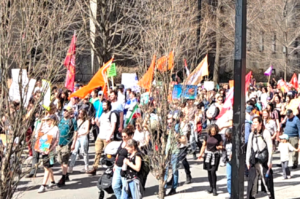
Polling Industrial Carbon Pricing page photo of climate march in Montreal and protect what we love exhibit in Ottawa.

Below a “No more cuts” protest against Government cancellations of climate policies and public sector cuts in 2026 in Montreal. Above an exhibit of climate disaster artefacts in Ottawa to call for an emissions cap in 2024.