Narratives on Energy: An Expanded Newsletter Introduction: September 1st, 2026
This is only an expansion on a part of our September 1st, 2026 eNewsetter. You can read the full newsletter at this link and sign up for future newsletters as well.
When doing my undergraduate degree in historical studies I had a professor who would often write a single word on sections of my essays in red pen: “CONTEXT.” I didn’t appreciate the significance at the time, but I do now. Moments in history like the one we live in now cannot be understood without context.
In these newsletter introductions I have tried to include precisely that: context to events that otherwise allows those events to be framed in misleading ways. I’m going, from time to time in these introductions, to start bringing in some insights from the realm of environmental history. Here’s a first one:
In William Cronon’s article, “A Place for Stories: Nature, History, and Narrative” about the different histories of the Dust Bowl and the Great Plains, Cronon argues environmental history is often told in narratives with beginnings, middles, and ends that can describe a transformation in the natural world. More importantly, such narratives can also be powerful drivers of how people treat the environment in different ways in their time periods, and what is included and excluded in these narratives matters:
“The very different scenes that progressive and declensionist narrators choose as the settings for their Great Plains histories bring us to another key observation about narrative itself: where one chooses to begin and end a story profoundly alters its shape and meaning.” – Cronon.
Where these narratives begin and end can be so powerful that even the people many might normally trust to be objective (journalists and Prime Ministers with backgrounds in economics, for example) can become swept up in them. Especially in moments when our sovereignty itself is threatened and emotion can operate in subtle ways on our capacity to think strategically. After all, narratives are an inescapable part of human existence, but not all narratives are equally valid nor immediately useful in the face of U.S. annexation threats.
What lies beneath the specifics of Canada-U.S. relations right now is a narrative about the future of our environment, energy, and the climate. That’s a bit of an understatement, actually, as getting other countries to use and extract more oil and gas is literally a goal of the 2025 U.S. National Security Strategy. As we discussed last week, the U.S. Government’s goal is to make Canada more “Trumpian” either by making us the 51st state or by scaring us into becoming a U.S. state in all but name.
Getting Canada to drill baby drill is a U.S. goal in and of itself and climate action an obstacle to U.S. energy dominance (again all the more reason to take climate action).
In the ‘Trumpian‘ world view we might well describe the desired future energy narrative to be as follows:
Canada contained large oil and gas reserves U.S. policy came to influence Canadian policy (both through appeasement, and through unstrategic attempts at resistance via oil and gas itself, Canadians were wrongly convinced that burning more oil and gas was necessary).
These reserves of oil and gas were extracted and burned for AI data centres because – for whatever justification suited the moment – it was felt they must be.
Resistance was quieted by the insistence that economics alone would lead to a renewable future, while simultaneously public money was used to keep oil and gas competitive with renewables for as long as possible.
This narrative excludes the climate impacts that follow, and the lack of an international market for more oil and gas expansion, which is of course the point. It is based on emotion and nostalgia for oil and gas – not pragmatism for the sake of Canada.
It takes the world as oil and gas lobbyists want it to be – rather than addressing the world ‘as it is’. It appeals to leaders, stuck in the nostalgia of a previous era, dreaming of nation building that inspired their youth, not the nation building that is needed now in a time of immense technological change.
[Some breaking news also from The Energy Mix – just now – that a publicly funded West Coast Pipeline Won’t Recoup Its $43.7B Cost as Global Oil Demand Weakens, according to the IEEFA.]
But this U.S. Government-driven narrative about the vitality of oil and gas is so strong in its influence on our policy that our Federal Government has even overlooked other ways to use petroleum products beyond specifically burning them to generate energy – let alone real wind and solar investment on the scale needed to counter the U.S. threat and a transition to using petroleum products as minimally as possible.
The false narrative that we need baseload power – from U.S. gas plants, U.S. managed nuclear, and over budget (locally destructive) mega hydro – when wind and solar with batteries can instead provide baseload, also helps reinforce the narrative of burning oil and gas.
For Trump’s friends in the oil and gas industry that is what matters, ultimately: that the oil and gas gets burned and the profits kept by the few: Drill baby drill reinforces oligarchy here, there, and everywhere.
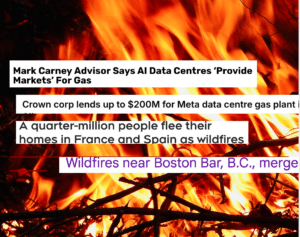
They would love us to power data centres for U.S. tech giants with gas (thus artificially creating a market for gas where other markets are declining). They want us to throw money away on anything but wind and solar (their competition) or wildfire response (which would suggest climate change is serious) – like for instance a marketless pipeline to the west coast.
But I would prefer to see a different narrative play out – one that accounts for what happens after fossil fuels are burned (or not burned) and for a pragmatic assessment of our immediate situation. A narrative that is neither progressive nor declensionist but simply practical and balanced given the information available (and one which acknowledges the existential importance of nature):
Canada contained vast reserves of oil and gas, but many people in Canada recognized these could not be burned in order to have a climate-safe future, that they had no market aside from an artificial one, and that real resistance to the U.S. meant going renewable.
The U.S. pressured Canada, and played every trick in the book to push for oil and gas expansion, and some leaders listened.
But, ultimately, people resisting such oil and gas expansion – along with the declining price and economic benefits of renewables – stopped expansion from happening.
We still have the power to decide which narrative we want historians to write about our time.
P.S. A few Newsletter additions:
Now back to the newsletter and much more content including events, actions items, and podcasts.
Written by Conor Curtis