
Federal Government Climate Betrayal & U.S. Energy Dominance – Resistance Grows!
Resistance is growing to the Canadian Federal Government’s climate betrayal, obviously pro-oil, pro-gas, policies and – clearly stated – decision to help support U.S. energy dominance. The Federal Government continues to show its true intentions with brand new cuts announced to wildfire response capacity for First Nations, refusals to meet with environmental groups on AI impacts, a decision to end a program for hiring diverse journalists and cuts to anti-disinformation initiatives. There are many other cuts to public services and even cuts to the space program.
The Federal Government is investing in the appearance of defence while letting U.S. oligarchy & energy dominance in through the back door.
Exemptions to clean electricity rules, direct federal advocacy of data centre build-out without strong conditions, and ever-more-doubtful state of the industrial carbon tax mean the Federal Government has helped enable Kevin O’Leary to pursue his gas-burning data centre in Alberta, which could even forgo environmental assessment.
Of course there’s the well debunked Alberta-separatism-4D-chess-excuse, which ignores that a majority of Albertans support climate action more strongly than the Federal Government does. It also ignores all the unnecessary things the Federal Government is doing that align with U.S. foreign and energy policy but have little impact on that topic; for example, harming our ability to fight disinformation and empowering corporations to lie, or cutting diplomatic capacity vital to disconnecting from the U.S. These things actually harm our ability to combat division in Canada. There really is NO secret 4D chess game to promote renewable energy – the only game being played is a game that enables people like Kevin O’Leary.
Again, the U.S. governments own – stated – strategy is to try to get countries like Canada to believe that, by backing oil and gas and tech interests, we are supporting our own interests when we are actually furthering U.S. interests in the process. The U.S. has demonstrated in its approach to Venezuela, Cuba, and Iran that it does not aim to necessarily replace a government – but seeks to control it from the inside.
Right on cue, the U.S. president’s friends in the Atlas Network are hard at work trying to convince Canadians that enabling U.S. corporate interests is good for Canadian sovereignty (it isn’t). That if we just appease them a little more (…and a little more… and a little more) we can prove that our sovereignty is useful – to Trump.
In reality, their game sets us up to become the U.S. Already we are at the point of possibly rejecting refugees from Gaza for the infraction of making a life-saving organ donation and eroding basic equality before the law to favour corporate interests. All this is being normalized, and falsely called pragmatic, just as it was normalized in the U.S. for decades (in no small part by the Atlas Network). That normalization led Americans to situation they are in now. All this sets us up for annexation, in name or in effect. This distortion of truths is the slowly boiling frog of discourse and it harms us all.
Talk about the economy vaguely all day – but what actually matters in situations like ours is who the economy works for: the many or the money. What matters is who has the influence by default.
Last week we talked about how the PM dismissed – by default – a Grassy Narrows First Nation member trying to raise awareness of mercury poisoning. It’s deeply disturbing to see that Grassy Narrows First Nation has since been denied federal funding to search for missing children and unmarked graves at a former residential school.
But what about the good things here and there that are being promised? In communications you need to watch the framing of things to truly understand intentions and the true direction of travel: watch what’s being normalized and how pragmatism is being framed and defined. That’s how you see past a ‘flooded zone.’ To not watch the framing is to watch the punches in a boxing match while ignoring the footwork. Fake pragmatists ignore the footwork.
Seeing what was coming, early on, wasn’t that difficult. Now, we are seeing the near complete capture of federal climate policy making by U.S.-aligned oil and gas interests. We’re being told to ignore the subject of climate justice. This while “gas flaring at LNG Canada far exceeds permitted volume” with health impacts from nosebleeds to respiratory problems already rising locally.
Only YOU stand in the way this erosion of truth, of health, of sovereignty, and of our climate…
More on what you can do about all this – by talking with others and organizing.
And of course you can call your MP about all this too.
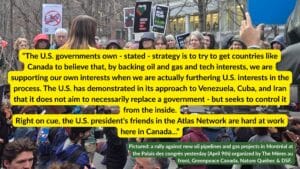
Pictured: a rally against new oil pipelines and gas projects in Montréal at the Palais des congrès yesterday (April 9th) organized by The Mères au front, Greenpeace Canada, Nature Québec & DSF.